
The World’s Most Profitable Bottleneck

There has been a narrative dominating semiconductor conversations for the last two years: NVIDIA, compute chips, accelerators, and the race to train the best language models. It is a valid and profitable narrative. But there is another story running in parallel, quieter and more technical, and from my perspective it has equally deep implications for those investing in the AI value chain.
That story is the memory chip supercycle.
And when I say supercycle, I am not talking about a typical bullish cycle in the semiconductor industry, the kind that lasts four or five quarters and then collapses because supply floods the market. I am talking about something structurally different: a mismatch between supply and demand that, according to the sector’s most solid projections, will not be resolved before 2028.
The analysis error most people make
The trap many people fall into when analyzing the AI ecosystem is confusing the visible layer of the problem with the real layer. The visible layer is compute: which GPU runs the models, who makes the accelerators, which architecture is more efficient. The real layer, the one that determines whether that compute can function at scale, is memory.
Without enough HBM — high-bandwidth memory — a $30,000 chip becomes a bottleneck waiting for data.
Modern transformers, the largest LLMs, and inference systems already deployed in millions of daily queries are all voracious in memory terms. And that voracity is fueling something we have not seen this clearly since the crypto-mining boom in 2021: a memory market in a state of structural, not speculative, euphoria.
The difference between a speculative cycle and a structural one matters.
The first deflates when the catalyst disappears.
The second persists because demand is anchored in a deeper economic transformation. And AI — model training, scaled inference, the proliferation of data centers — is not a catalyst that will disappear.
The numbers
I want to be precise here because the data is striking.
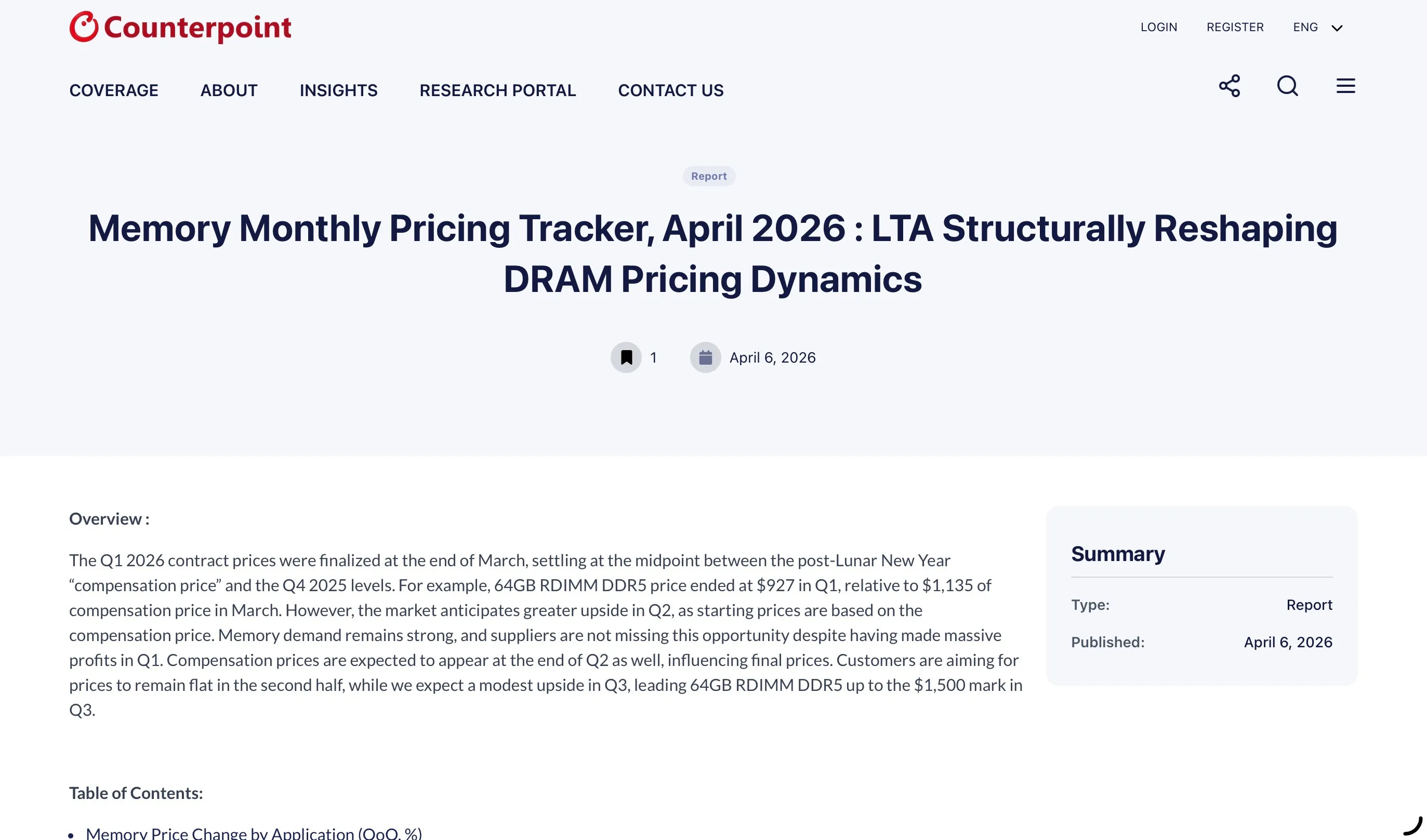
According to Counterpoint Research, DRAM contract prices rose between 40% and 70% in the first quarter of 2026 alone. NAND flash prices rose as much as 38%. That comes on top of a base that had already risen 50% during 2025. By mid-2026, we are talking about memory prices that have nearly doubled versus 2024 levels.
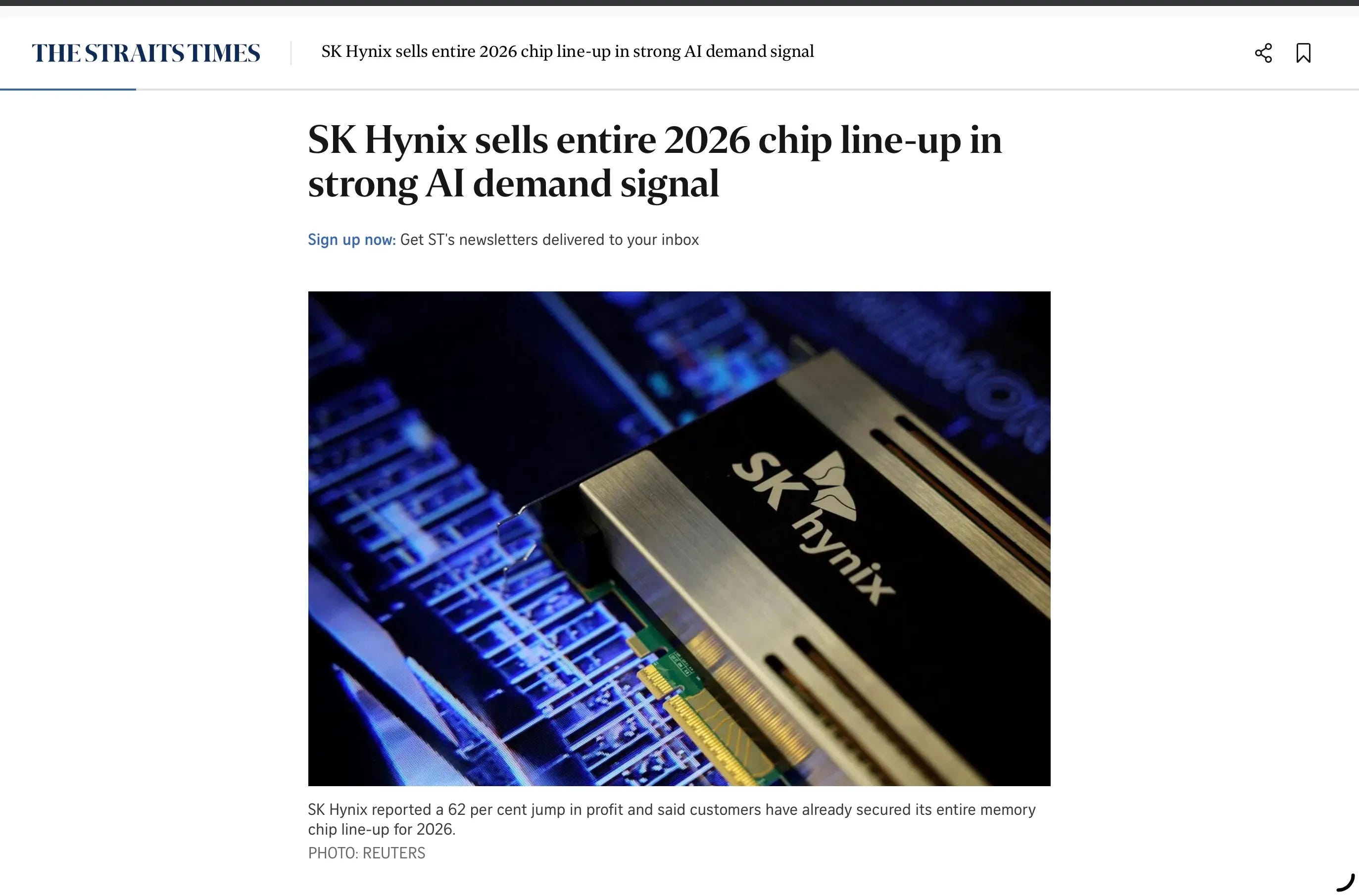
SK Hynix stated in its quarterly report something rarely heard in semiconductors: all of its 2026 chip production has already been sold. There are no units available in the spot market. Samsung and Micron are raising server memory prices by up to 70% in this same quarter. And Nomura Securities projects that the bullish cycle will last at least through 2027, with significant new supply arriving only in early 2028.
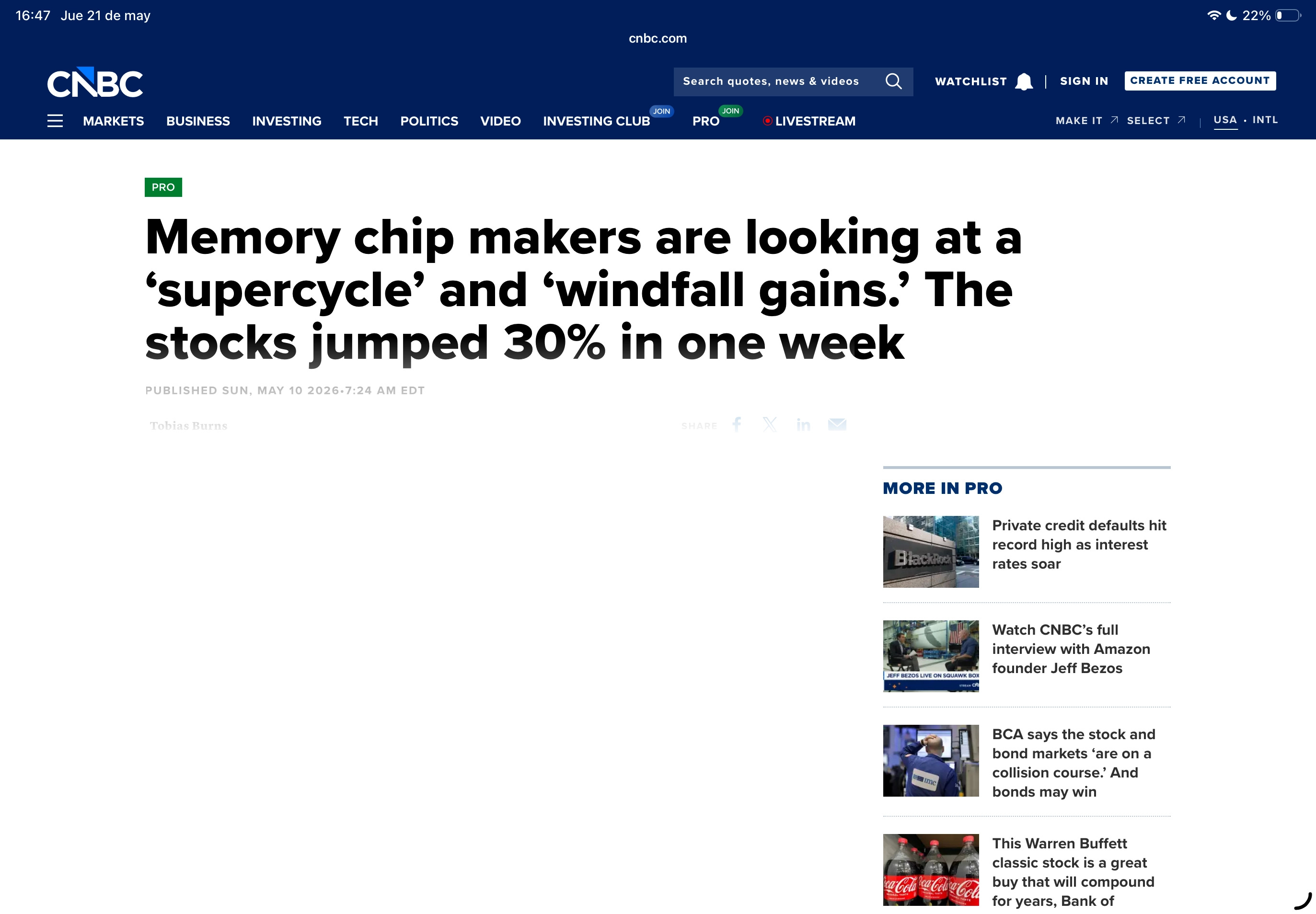
In stock-market terms, Micron Technology rose 247% over the last year, with its first trading session of 2026 posting a 10.5% jump. SK Hynix extended gains from an outstanding 2025. Samsung repositioned itself as an institutional favorite.
And SanDisk — after its spinoff from Western Digital — accumulated more than 800% appreciation in twelve months. These are not speculative small-cap moves: they are industrial giants being re-rated because the market is finally understanding the scale of what is happening.
Why supply cannot simply respond
A legitimate question any analyst should ask is: if prices are soaring, why don’t manufacturers simply build more capacity? The answer is that it is not that simple, and here lies the core of the argument for a prolonged supercycle.
First, advanced memory semiconductor fabs are not built in months. A new fab takes between two and three years to become operational from the moment construction begins.
That means any expansion decision made today will not translate into real supply before 2028.
And second, and this is critical, HBM — the most in-demand memory for AI — requires advanced packaging techniques that are fundamentally different from conventional DRAM. The process is more complex, manufacturing yields are lower, and the production-tool chain is dominated by just three players: SK Hynix, Samsung, and Micron.
SK Hynix currently holds 62% of the HBM market. Micron has 21%. Samsung has 17%. That is a de facto oligopoly, and the three players have perfectly aligned incentives not to destroy pricing structure by expanding aggressively. In fact, the narrative describing Samsung diverting part of its HBM capacity toward DDR5 RDIMMs to serve other market segments confirms that manufacturers are actively managing scarcity to maximize margins.
We are not looking at a market failure or a temporary incapacity.
We are looking at an industry that learned the painful lesson of the 2022–2024 period, when oversupply crushed margins, and that is now operating with unusual capital discipline for the sector.
That discipline is the supercycle’s duration insurance.
The other side: the losers
Every supercycle has winners and losers, and the analysis would be incomplete without looking at the other side. Rising memory costs do not stay in SK Hynix and Micron’s balance sheets. They spread through the entire value chain, and not everyone can absorb them equally.
Apple is the most visible example.
Its shares fell roughly 7% from their December 2025 highs, with Macquarie analysts directly pointing to rising memory costs as a key factor.
An analyst at that firm put it bluntly: “the memory shortage is deepening, choking the entire IT supply chain.” Consumer-device makers — PCs, consoles, electronics — cannot easily pass these cost increases on to end consumers without sacrificing sales volume.
This creates a very interesting divergence in the technology ecosystem. On one side, data centers and hyperscalers (Amazon, Google, Microsoft, Meta) have the pricing power and margins to absorb higher memory costs without breaking their business models.
In fact, many of them have signed multiyear contracts directly with manufacturers, securing supply in exchange for price visibility. On the other side, consumer hardware makers are caught between already thin margins and input costs that keep rising.
This divergence is, in my view, one of the richest analytical elements of the supercycle: it is not only about identifying which companies win directly, but which ones lose indirectly, and whether that loss is already reflected in their valuations.
The investment angle: how much is already priced in?
This is where the analysis gets genuinely interesting, and where I move away from a purely bullish narrative.
Micron at +247% in one year, SK Hynix at all-time highs, Samsung being upgraded by virtually every relevant research house: the market is not asleep to this supercycle.
The question any serious investor must ask is not whether the supercycle is real — the data confirms that it is — but how much of it is already reflected in current prices.
At the beginning of 2026, for example, Bernstein raised its price target for Micron from 270 to 330 dollars, while the stock was still trading below 300. Today Micron is already around 1,000 dollars per share and at times has surpassed 1 trillion dollars in market capitalization, while firms like UBS and Susquehanna are working with targets between 1,600 and 1,750 dollars, far above the levels that seemed aggressive only a few months ago.
That gap between the speed of the price move and the caution of consensus models is exactly what leads me to temper that optimism with a few uncomfortable questions.
First: what happens if AI capex demand moderates in 2027? Not because AI disappears, but because infrastructure investment cycles can have their own ups and downs even within a secular trend.
Second: how durable is SK Hynix’s HBM4 advantage if Samsung resolves its yield problems in the next generation?
And third: AI memory demand is highly concentrated in a handful of customers (NVIDIA, Google, Microsoft). A shift in hardware architectures — such as a move toward accelerators with more on-chip memory — could reduce dependence on external HBM.
I am not saying these risks are likely in the short term. I am saying an honest analysis must name them, and that an investor entering the trade today should do so with open eyes about the fact that a meaningful part of the upside is already priced in.
Have you read my latest Deep Dive yet?
In-depth analysis and rating of the companies I follow.
Where I see less obvious value
My view is that the most interesting value in this supercycle is no longer in the three memory manufacturers, which have already attracted a great deal of attention and where valuations are starting to look demanding. It is in two less obvious places.
The first is the equipment ecosystem: companies like ASML, Applied Materials, and Lam Research are critical suppliers of the manufacturing tools that enable advanced HBM production.
Any capacity expansion, however disciplined, requires capex in tools. And these companies have an oligopoly in certain equipment segments — ASML’s EUV lithography is the canonical example — which gives them their own pricing power, with lower volatility than chip makers because their demand is smoother over time.
The second interesting area is the data-center infrastructure that hosts the servers consuming this memory. Data-center REITs and colocation operators have an indirect exposure to the memory supercycle that the market tends not to analyze as such.
When memory scarcity makes AI servers more expensive, existing infrastructure gets used more intensively, and the operators of that infrastructure capture more value per rack.
A final reflection on the narrative
I’ll close with something that goes beyond financial analysis. The memory supercycle is, in a sense, a mirror of how technological transformation works in the real economy. The glamorous part — language models, interfaces, demos — grabs the headlines. But underneath, in the physical layers where computing actually happens, there is a chain of material dependencies that no amount of software can escape.
Memory is one of those dependencies. And the market, which for years treated DRAM and NAND makers as cyclical producers of cheap commodities, is now recalibrating that narrative. SK Hynix does not make a commodity.
It makes the component without which the models transforming entire industries cannot function at scale. That is a narrative repositioning with real valuation consequences.
The question I keep asking myself, and the one I think any investor who wants to truly understand this theme should ask, is this: when the market finally completes this revaluation of memory manufacturers, what will be the next physical link in the AI chain that is being systematically ignored? Because there is always one. And finding it before the consensus does is, ultimately, the game.
This analysis represents a personal opinion based on a review of the company’s public reports and does not constitute investment advice.