
The Processor Battle: NVIDIA Vera vs AMD EPYC in the Age of the Agentic Shift

There’s a quiet but profound shift happening at the heart of the world’s data centers. For years, the artificial intelligence narrative gravitated almost exclusively around GPUs —NVIDIA’s graphics cards that trained ChatGPT, Gemini, and the models we use daily.
But AI evolved.
It stopped being a model that answers questions and became an agent: a system that plans, executes code, queries databases, calls APIs, makes decisions, and orchestrates tasks in sequence.
This changes everything, because those tasks aren’t work for a GPU.
They’re work for a CPU.
This is the Agentic Shift: the transition from the model-training paradigm —GPU-intensive— toward the deployment of AI agents in production, where the CPU becomes the “brain” of the system once again.
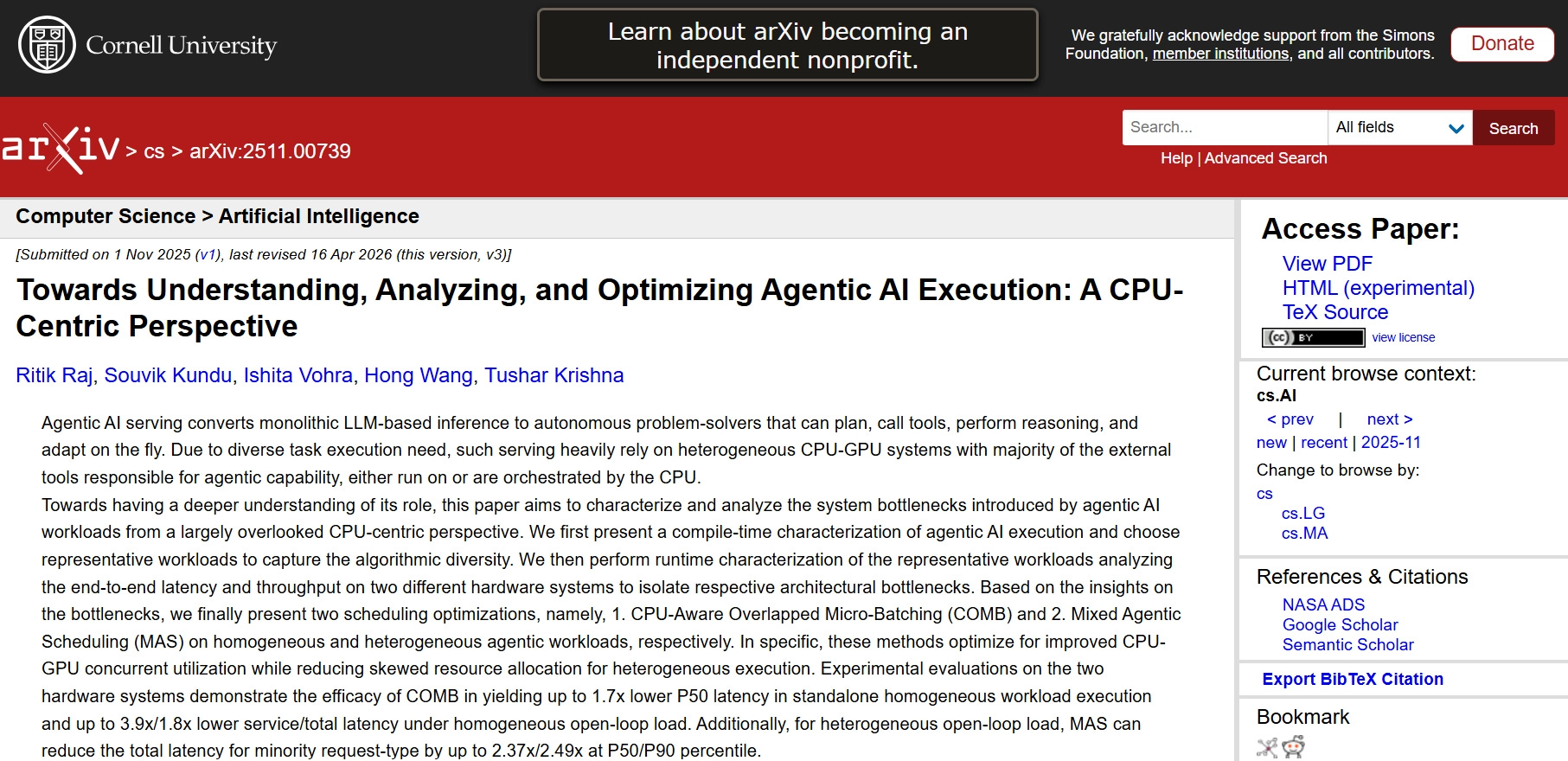
Research from Cornell University quantified that Agentic AI workflows depend on CPUs for approximately 44% of their total compute power —a three-to-fourfold increase versus traditional AI tasks.
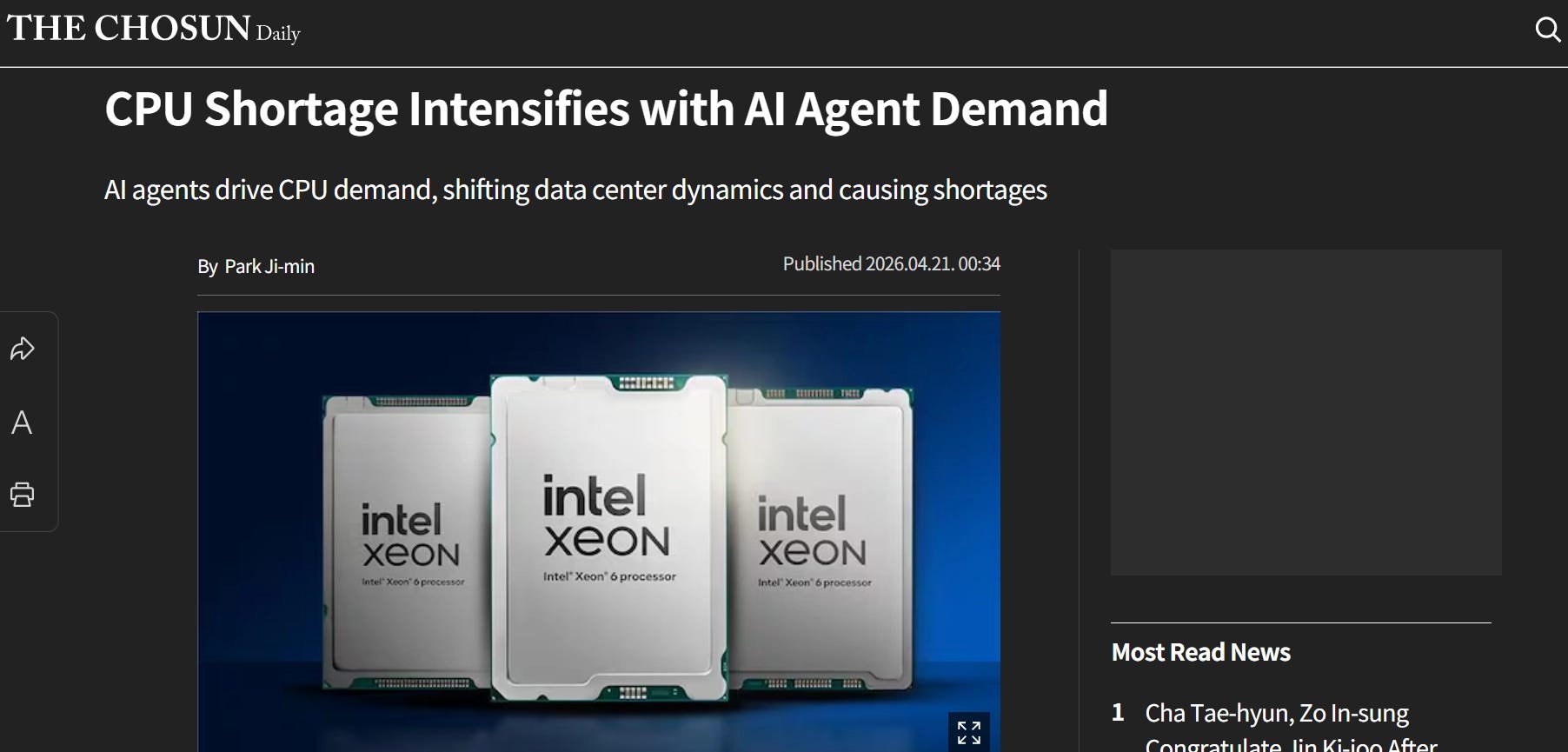
TrendForce goes further: while current AI data centers require 30 million CPU cores per gigawatt, the agentic era will demand up to 120 million cores, and the CPU-to-GPU ratio will shift from 1:8 to 1:1, or even 1:2.
On its Q1 2026 earnings call, Intel’s CFO confirmed this trend, noting that ratio had already adjusted from 1:8 to 1:4, on a trajectory toward parity. HSBC Securities, responding to this new environment, revised its 2026 global server shipment growth forecast from 4% to 20% year-over-year.
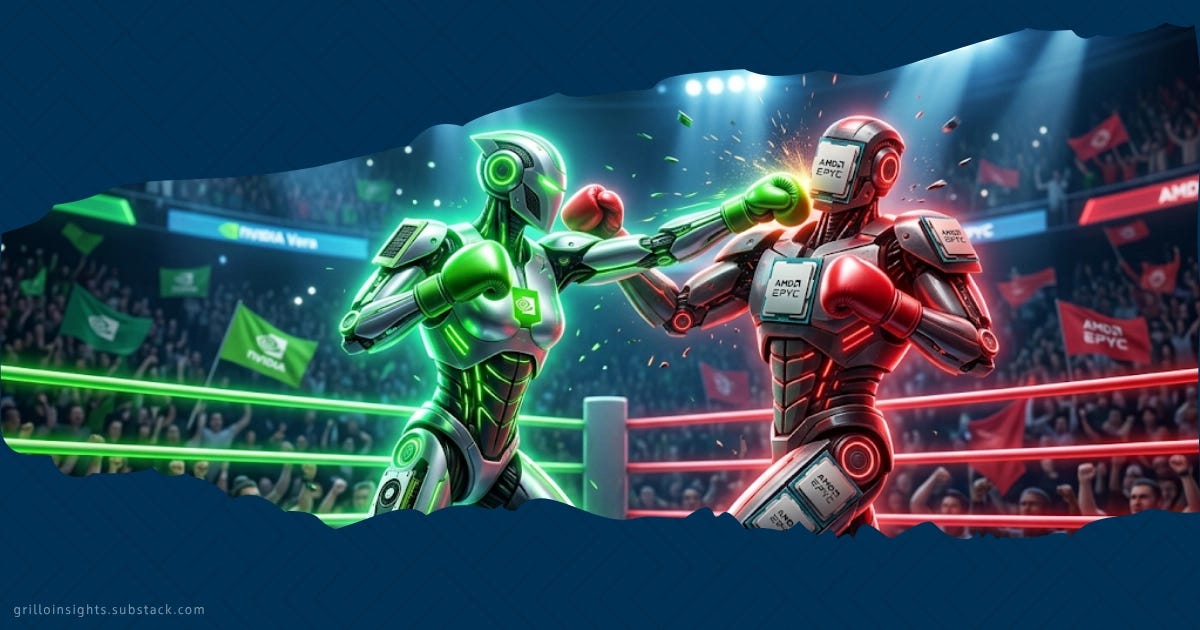
This is the context in which the real debate we’re addressing is born: who will capture the massive CPU demand that the Agentic Shift is generating?
Today, the answer has two names: NVIDIA Vera and AMD EPYC.
The New Contender
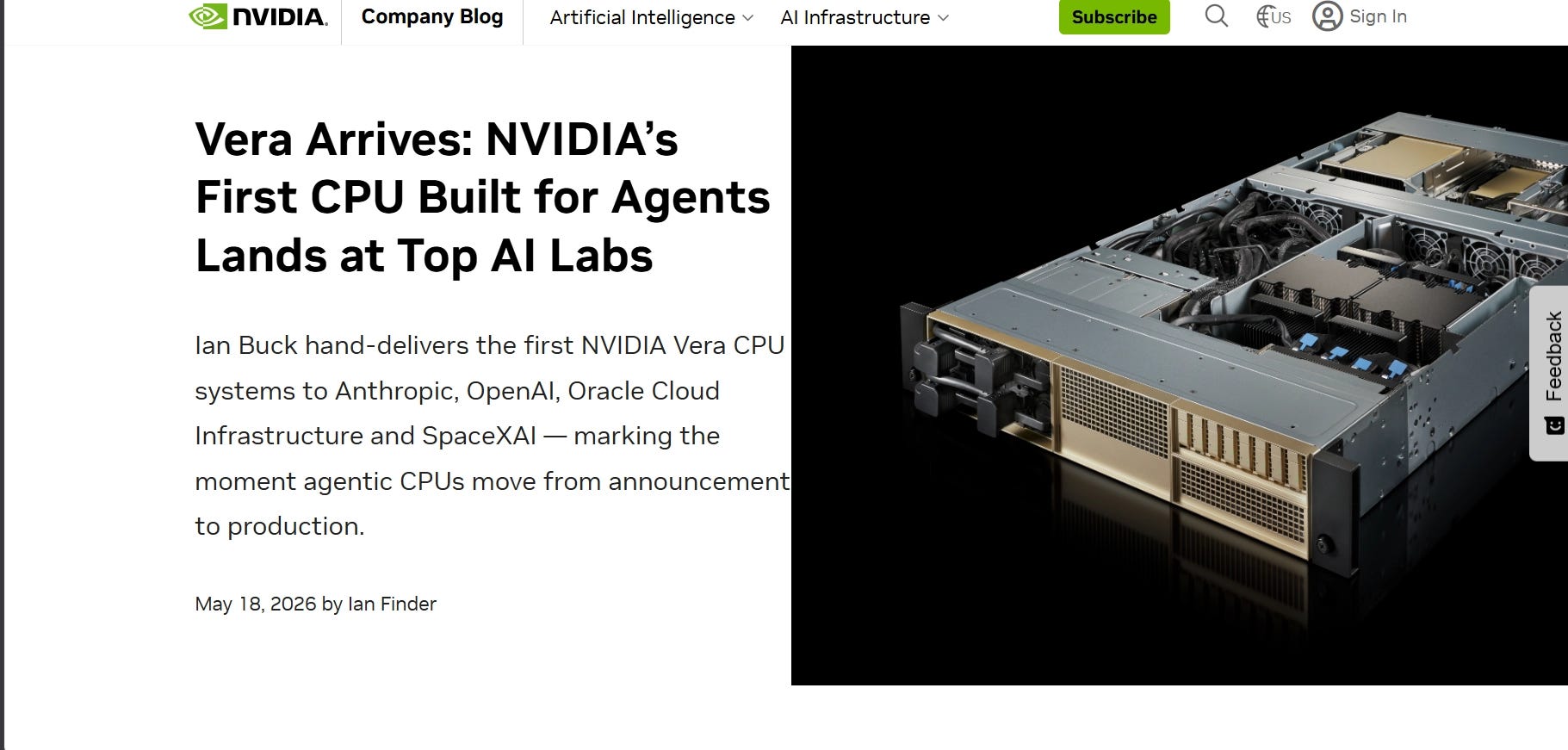
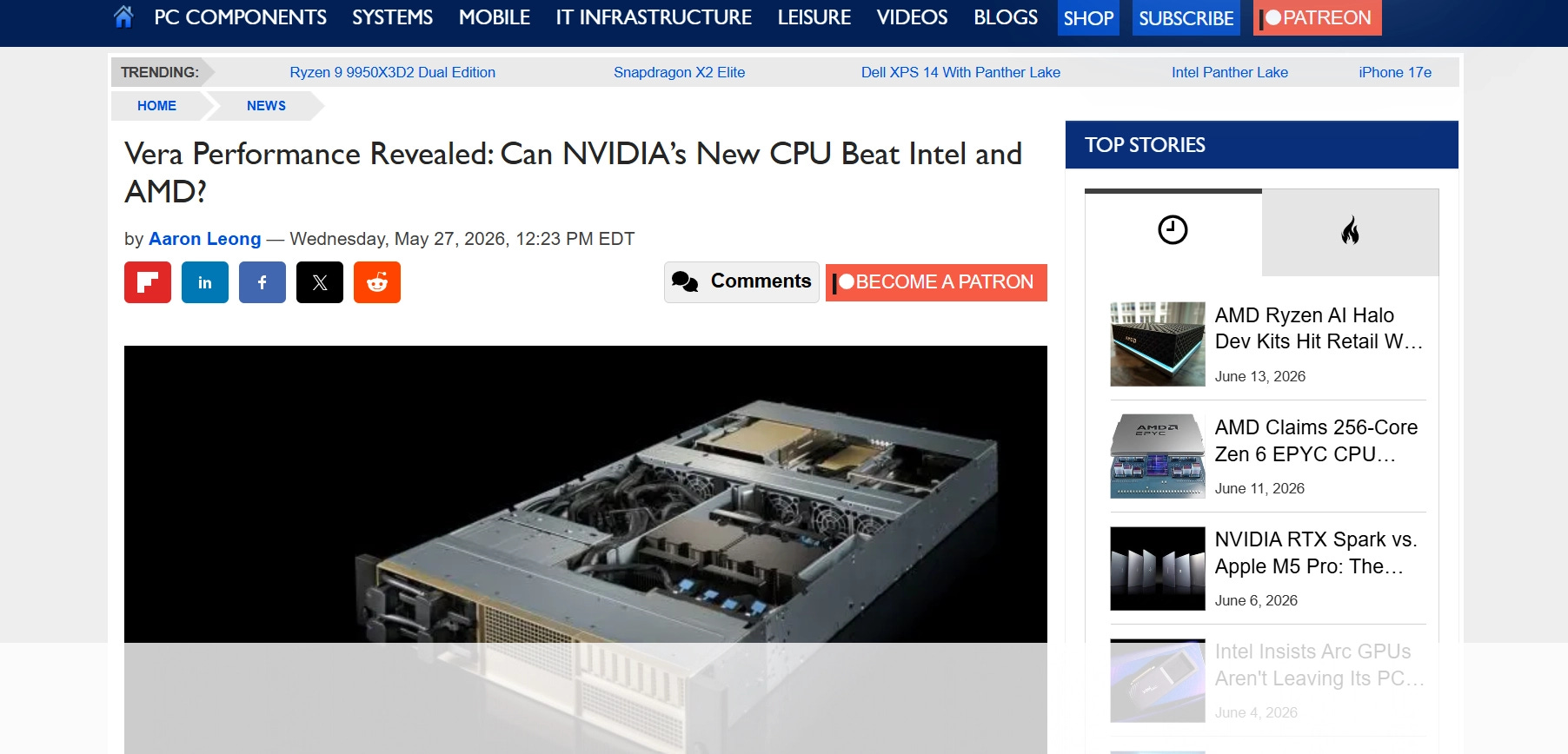
NVIDIA NVDA 0.00%↑ entered the server CPU ring with a bold punch. Vera, its first custom production CPU, was delivered to OpenAI, Anthropic, Oracle Cloud Infrastructure, and SpaceXAI in May 2026.
It’s not a peripheral product: it’s the cornerstone of the Vera Rubin platform, the most powerful AI computing ecosystem NVIDIA has ever designed.
Technically, Vera impresses. Its 88 custom “Olympus” cores —built on ARMv9.2 with proprietary modifications— are paired with 1.5 TB of LPDDR5X memory and 1.2 TB/s of bandwidth, figures that far exceed anything offered by x86 server CPUs today.
The key to its architecture is integration: connected to Rubin GPUs via 2nd-generation NVLink-C2C with up to 1.8 TB/s of coherent CPU-GPU bandwidth —roughly 7 times what PCIe Gen 6 allows— Vera isn’t designed to exist on its own.
It’s designed to be the heart of an ecosystem.
And in raw performance, early independent benchmarks from Phoronix (May 2026) show that Vera outperforms AMD’s EPYC 9575F by a geometric mean of ~10-11% across varied data center workloads. Against Intel’s Xeon 6980P, that advantage climbs to ~55%.
These are not small numbers in the world of server processors.
The Defending Champion
AMD AMD 0.00%↑ has spent years quietly building the most remarkable trajectory in the modern history of server semiconductors.
With its Zen architecture, it went from irrelevant to capturing a server CPU market share that has climbed from ~25% in 2023 to approximately 39-41% in 2025, while Intel consistently declined.
The 4th-generation EPYC (9004 series, all-Zen 4 architecture) offers up to 128 x86 cores, DDR5 support with up to 460.8 GB/s of bandwidth, and TDPs ranging from 200 W to 400 W in its top-performing models.
It’s not as spectacular as Vera on paper, but it carries an advantage no technical spec sheet can fully capture: universal compatibility with the x86 ecosystem.
Most of the world’s data centers are built on x86 architecture. Migrating to ARM —Vera’s base architecture— isn’t just expensive in hardware; it means:
Recompiling software
Retraining teams
Revalidating entire pipelines, and
Assuming operational risk.
It’s an architecture change, not an upgrade. For the universe of industries that aren’t top-tier hyperscalers —manufacturing, finance, healthcare, retail, government— that leap simply isn’t viable in the short term.
AMD knows this. And it has a response ready for the agent ring.
Other AMD’s posts


The Most Important Round
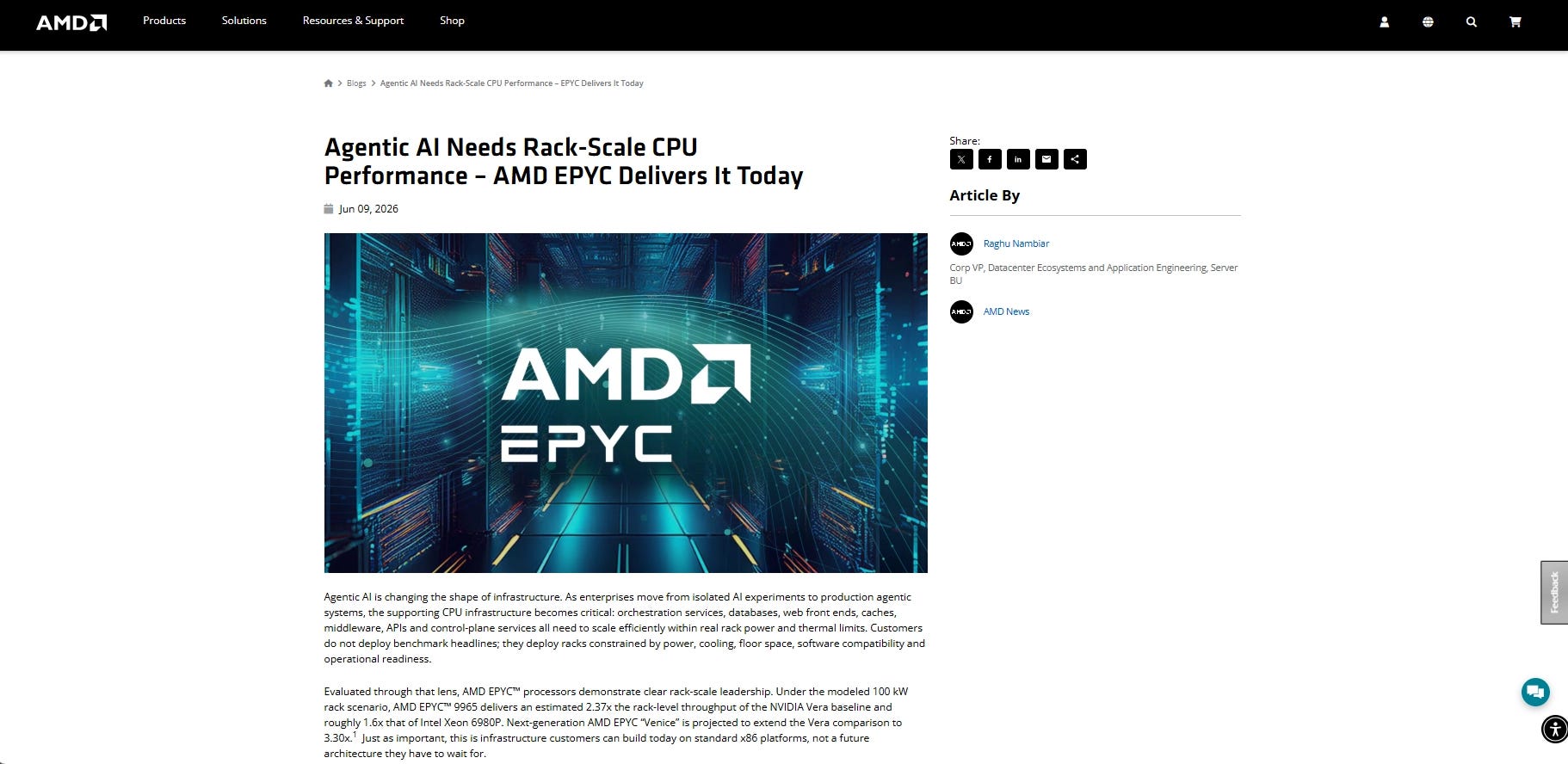
On June 9, 2026, AMD published its official blog on EPYC in the agentic era and revealed the first performance projections for “Venice,” its next 6th-generation CPU with up to 256 Zen 6 cores and a 2nm process, slated for 2027.
The number it dropped is provocative: in a 100 kW rack, Venice would deliver 3.3 times the performance of Vera. A claim that —full honesty here— is based on the company’s own projections and estimates, not on real hardware benchmarks.
But even that caveat matters.
AMD also revealed that its 64-core Venice (Zen 6) would hold a 27% per-core performance advantage over Vera, and that even the 96-core version would maintain an 11% per-core edge over NVIDIA’s 88-core chip.
At this point, the numbers war is a game of benchmark selection —NVIDIA picked its own for Phoronix, and AMD picked its own for Venice. Both win when they choose the terrain.
The definitive reality will arrive once Venice is actually in production.
What is official: AMD confirmed Venice’s 2027 production, with support for LPDDR memory for agentic workloads —adopting the same high-speed memory logic NVIDIA implemented in Vera— and positioned as the host CPU for Instinct MI500 GPUs.
NVIDIA’s competing ecosystem is already under construction.
The Real Battlefield: Ecosystem vs. Market
NVIDIA doesn’t just offer a CPU. It offers the most integrated AI computing ecosystem on the planet:
Vera CPU + Rubin GPU + NVLink + InfiniBand + CUDA + cuDNN + TensorRT.
It’s a complete stack where every component amplifies the others.
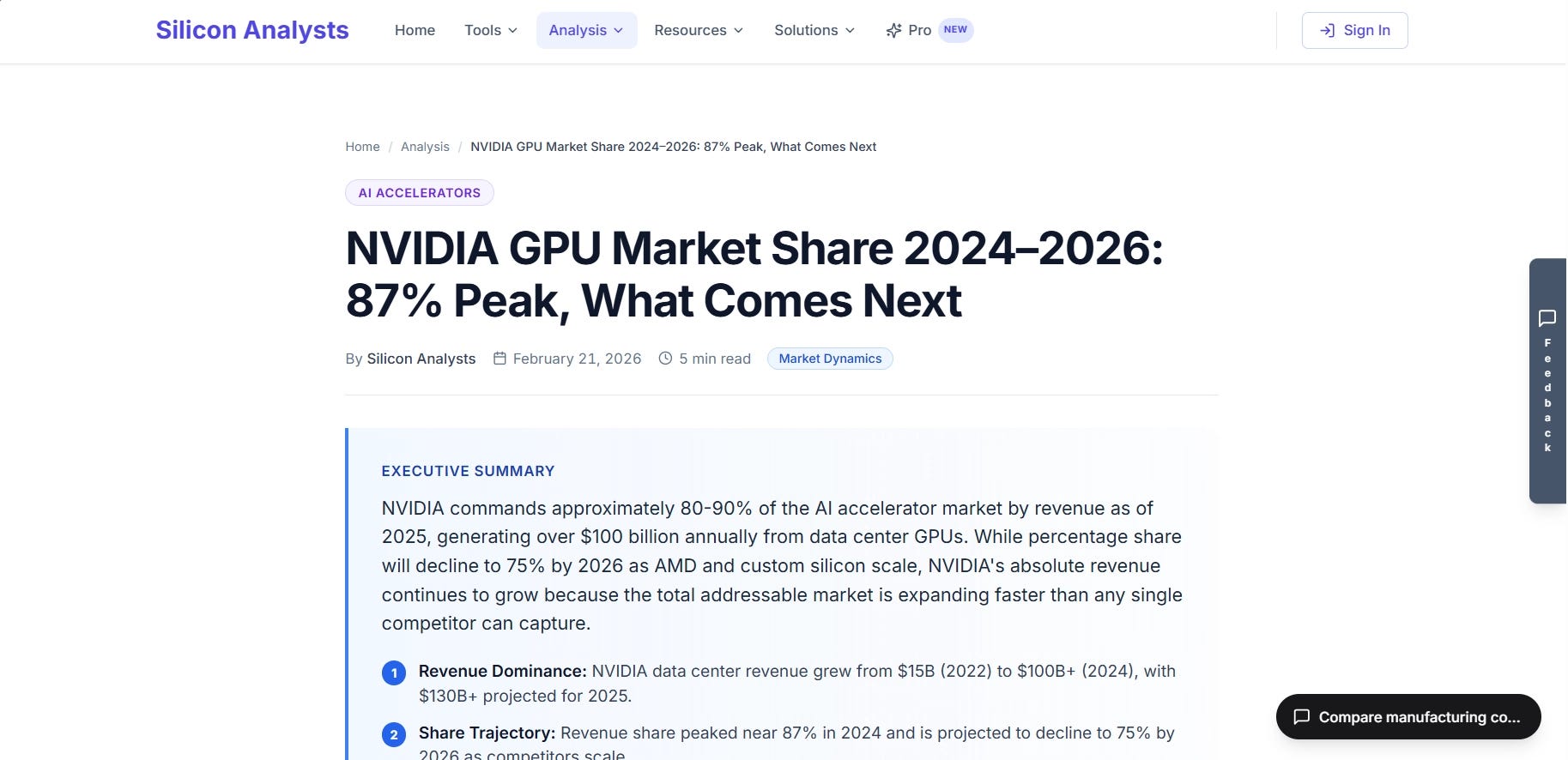
And CUDA —with more than 4 million active developers and over 20 years of maturity— remains the hardest moat to cross in the industry. NVIDIA maintains gross margins in the mid-70% range and dominates 80-90% of the AI accelerator market by revenue.
Its data center revenue grew 68% year-over-year in FY2026.
AMD competes on different, but equally powerful, ground: cost-efficiency and openness.
ROCm 7.x —its open-source alternative to CUDA— has finally reached maturity as a real alternative in 2026, with full integration into PyTorch and Hugging Face. That has unlocked massive hyperscaler commitments aimed at breaking free from NVIDIA dependency.
The logic is simple and has nothing to do with engineering: hyperscalers —Google, Meta, Microsoft, Amazon— are fed up with NVIDIA’s pricing. An H100 costs NVIDIA roughly $3,320 to manufacture and sells for up to $28,000. That margin isn’t sustainable long-term from the buyer’s perspective.
AMD delivers performance that, in many inference scenarios, sits in the same order of magnitude as NVIDIA but at a fraction of the cost and without requiring an architecture migration.
That value proposition explains why hyperscalers signed multi-gigawatt deals with AMD in 2026.
The Risk
There’s a third force in this ring that complicates the analysis: hyperscalers are building their own chips.
Google, with its TPU v7 (Ironwood), delivering 4,614 FP8 TFLOPS with 192 GB of HBM3E per chip and reporting 4x better price-performance than the H100 for LLM workloads.
Amazon, with Trainium 3 and Graviton 5 (192 ARM cores, TSMC’s 3nm process).
Microsoft, with Maia 2.
Meta, with MTIA 2.
Combined, hyperscalers are estimated to deploy approximately 1.9 million custom accelerators in 2026 —including ~900k Google TPUs and ~600k AWS Trainium units.
Their primary goal isn’t necessarily outperforming NVIDIA. Their goal is reducing dependency on NVIDIA to keep prices in check. Google and Amazon even announced in 2026 plans to sell their own chips to third parties, becoming direct competitors within the commercial ecosystem.

This means the pie AMD and NVIDIA are fighting over in CPUs and GPUs has a third diner at the table with unlimited pockets.
And that, perhaps, is the most underestimated systemic risk in the equation.
There Is No Single Winner
The Agentic Shift won’t create a single-winner market. It will create differentiated demand segments, each with its own leader.
NVIDIA is better positioned to capture the market of hyperscalers building the world’s most advanced AI infrastructure. Adopting Vera is costly, yes, but hyperscalers already living inside the CUDA ecosystem have no real incentive to leave if what they want is maximum performance in frontier training and inference.
For that segment, the full Vera + Rubin ecosystem is a hard proposition to refuse.
AMD holds the larger market, measured by number of installations. The vast majority of the world’s data centers —conventional industries just beginning to integrate AI as one more workload— run on x86 and have neither the budget nor the risk tolerance for an architecture migration. For them, EPYC offers competitive performance, full compatibility, and an adoption cost orders of magnitude lower. That thesis isn’t just theoretical; it also explains why AMD makes up 28% of our portfolio and why we haven’t sold a single share.
If AI becomes just another workload —the way big data once did— AMD is sitting in the right seat.
The critical variable that will determine how that pie gets carved up is the speed of the inference market across each industry.
If agentic AI demand moves so fast that NVIDIA can’t keep up with Vera supply —a plausible scenario given its track record of chip shortages— AMD will directly benefit from that bottleneck. And with Venice arriving in 2027, it’ll have a high-level technical answer ready for that moment.
I don’t believe NVIDIA is headed for a collapse like Intel’s. CUDA’s moat, its vertical integration, and Jensen Huang’s innovation cadence are too structural for that to happen in this cycle. But I do believe the market AMD is building —quieter, broader, more accessible— could turn out to be, in terms of total deployed unit volume, the bigger of the two markets.
And in technology, volume writes history.
This analysis represents a personal opinion based on a review of the company’s public reports and does not constitute investment advice.